
When you are installing a kitchen or renovating a bathroom, you cannot stop every time the phone rings. You have to put down your tools, step away from the job, find somewhere quiet enough and try to understand an enquiry that may still be very vague.
But not answering creates another problem. The caller could be a homeowner with a genuine project who simply wants to know whether the company serves their area and can arrange an appointment. If nobody answers, they will often continue their search elsewhere.
This is the problem an AI voice agent can solve: handling the first conversation without replacing the contractor in the customer relationship.
For the past four months, Automatyz has been supporting a three-person US contracting business specialising in kitchen and bathroom remodelling. The company and its exact location remain confidential, but the system described here is used in its day-to-day operations.
The need is not unique to the United States. The same setup can be adapted for a small trade business elsewhere by changing the questions, service area, transfer rules and data-handling framework.
The real problem was not the phone. It was the interruption
Before the agent was introduced, the owner was regularly interrupted while working on site. He had to choose between two bad options: answer in the middle of a job or let the phone ring, knowing that a serious enquiry might be lost.
A small business does not always have someone dedicated to answering calls. The same people carry out the work, travel between jobs, prepare quotes, speak to customers and organise upcoming appointments. Every incoming call therefore demands the attention of someone who was already doing something else.
The aim was not to prevent prospects from reaching the company. It was the opposite: every enquiry needed to be handled while protecting the team's working time.
An AI voice agent does not need to replace the contractor
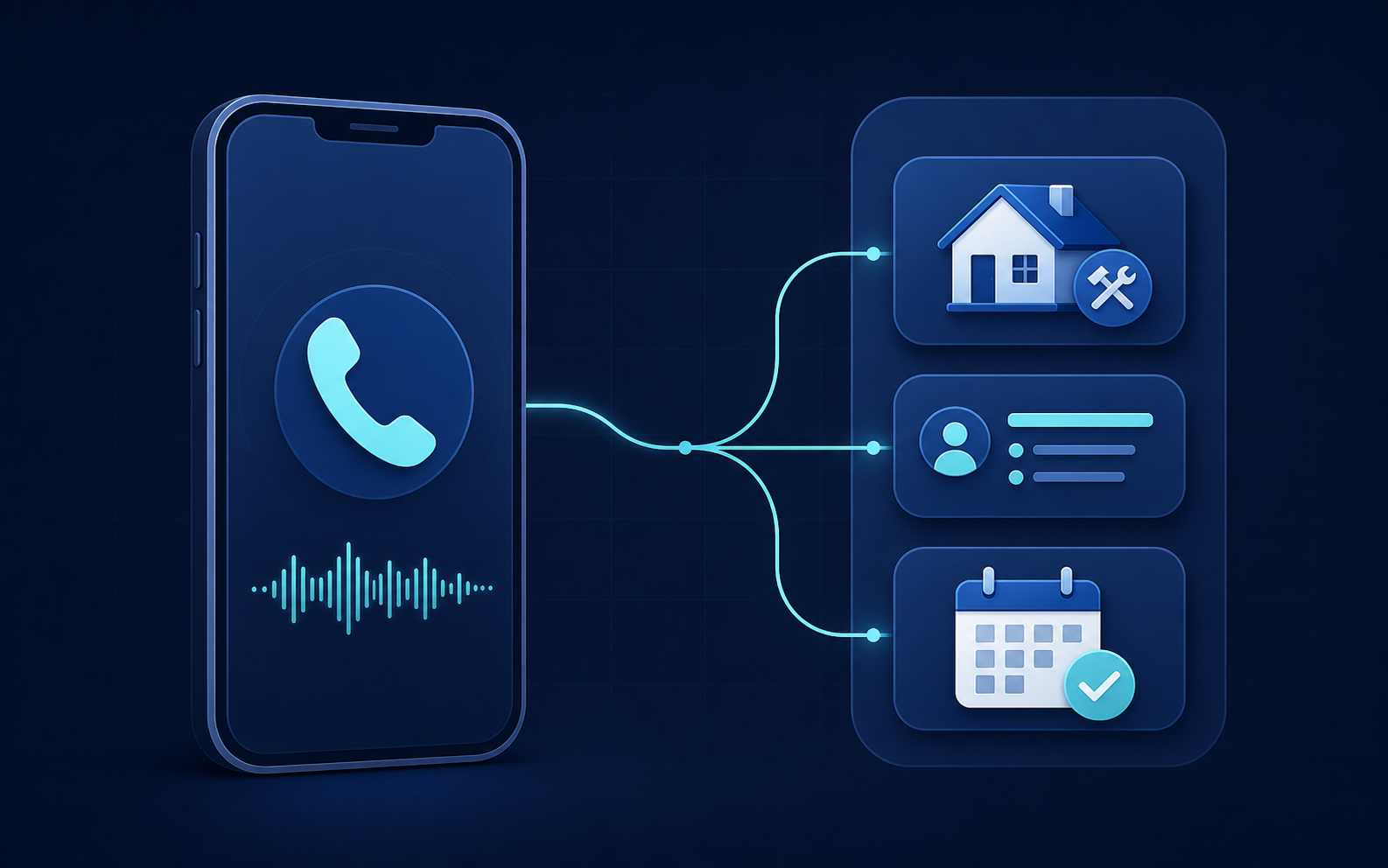
In this case, the voice agent acts as a first-line receptionist. It welcomes the caller, understands why they are calling and collects the information the contractor will need to continue the conversation.
Depending on the situation, the call can then lead to several outcomes:
- an appointment can be offered;
- the caller can be transferred to someone in the company when necessary;
- a voicemail can be left for the contractor to review later;
- the enquiry can be recorded in the CRM for follow-up.
The exact transfer, follow-up and handling rules are deliberately not explained here. They are specific to the business and form part of the system's safeguards.
The essential idea is simpler: the agent prepares the conversation, while the human keeps control of the decision, the technical advice and the commercial relationship.
Qualifying a call does not mean deciding for the business
The word “qualify” can suggest that the AI scores a prospect or decides whether their project deserves a response. That is not its role in this system.
The agent gathers useful information. It can ask, for example:
- what kind of work the caller is considering;
- whether the caller owns the property;
- whether they would like to speak to someone;
- where the project is located.
For a contractor working within a defined service area, the caller's city, ZIP code, postcode or region can be used to check whether the project is in range.
The agent then passes the enquiry on. It does not diagnose the work, promise a price or decide on its own which customers the company should accept. This boundary matters: good automation prepares human work; it does not try to remove professional judgement.
The information does not stay trapped inside the call
Answering the phone is not enough if the contractor still has to replay every conversation, copy contact details and remember who needs a follow-up.
In the system implemented by Automatyz, every person who contacts the company is created or updated in the CRM, together with the status that reflects the progress of their enquiry. When a caller does not complete the initial conversation, the system triggers follow-up based on the rules agreed with the contractor. The owner also receives regular summaries of the conversations, giving him a clear overview without having to monitor the phone throughout the day.
The voice agent therefore becomes the first step in a broader follow-up process: the call is handled, the information is organised and the next action is not left to chance.
Four months later: fewer interruptions and more appointments
After four months of use, the effects observed by the company are clear:
- far fewer interruptions while work is being carried out;
- no call left without being handled by the system;
- more enquiries progressing to an appointment, either booked by the agent or finalised by the contractor;
- more consistent follow-up with people who did not complete their first conversation.
Among callers who have a real conversation with the agent, 58% go on to book an introductory appointment with the contractor. This figure relates to this specific case over the period observed. It is not a promise that applies to every business: results depend on the trade, where calls come from, the company's reputation and how the journey is designed.
One customer was convinced by the handover from AI to human
One conversation captures the role of the system particularly well.
A person had recently moved to the city where the company operates and wanted to renovate a house. She found the contractor through the company's positive online reviews and called to discuss her project.
At first, she did not immediately realise that she was speaking to an AI. She noticed during the call and was surprised, but the conversation remained clear enough for her to continue.
The agent collected the initial information and arranged the next step. The contractor then took over the relationship personally. The customer did not buy a service “from an AI”: she received an immediate response, followed by the expertise of a professional. The project was signed less than four days after that first call.
The story shows why the system works: AI reduces the wait and prepares the conversation; the human builds trust and closes the project.
When is an AI phone assistant useful for a contractor?
An AI voice agent can be relevant when several of these situations occur repeatedly:
- the phone rings while people are on site or travelling between jobs;
- missed calls may represent future quotes;
- the same questions come up at the beginning of every enquiry;
- the service area needs to be checked;
- some calls need a quick response, but not all of them;
- contact details and follow-ups need to be tracked in a system;
- the company wants to offer appointments without adding more back-and-forth.
However, the most sophisticated solution is not always the best one. If the company receives very few calls, if every enquiry immediately requires technical expertise or if a simple menu is enough to direct callers, a well-organised voicemail or interactive voice response system may be more appropriate.
The right question is not, “Can we put AI on the phone?” It is: “What do we need to understand about a call before the contractor genuinely needs to step in?”
How can you tell whether your calls could be handled more effectively?
Before choosing a tool, you need to look at how the business actually operates: why people call, when those calls arrive, which information is always requested and which situations genuinely require an immediate response.
The same principle applies to any useful automation: start with a repetitive task that is clearly understood, then build around the habits that already work.
A good voice agent is not trying to hold the most impressive conversation possible. It needs to ask the right questions, pass on information that can be used and know when to hand over to a person.
If calls regularly interrupt your work or enquiries disappear before you have time to call back, we can look together at what an automated phone receptionist could handle — and what should remain human.
Review how your calls are handled in a 30-minute conversation