
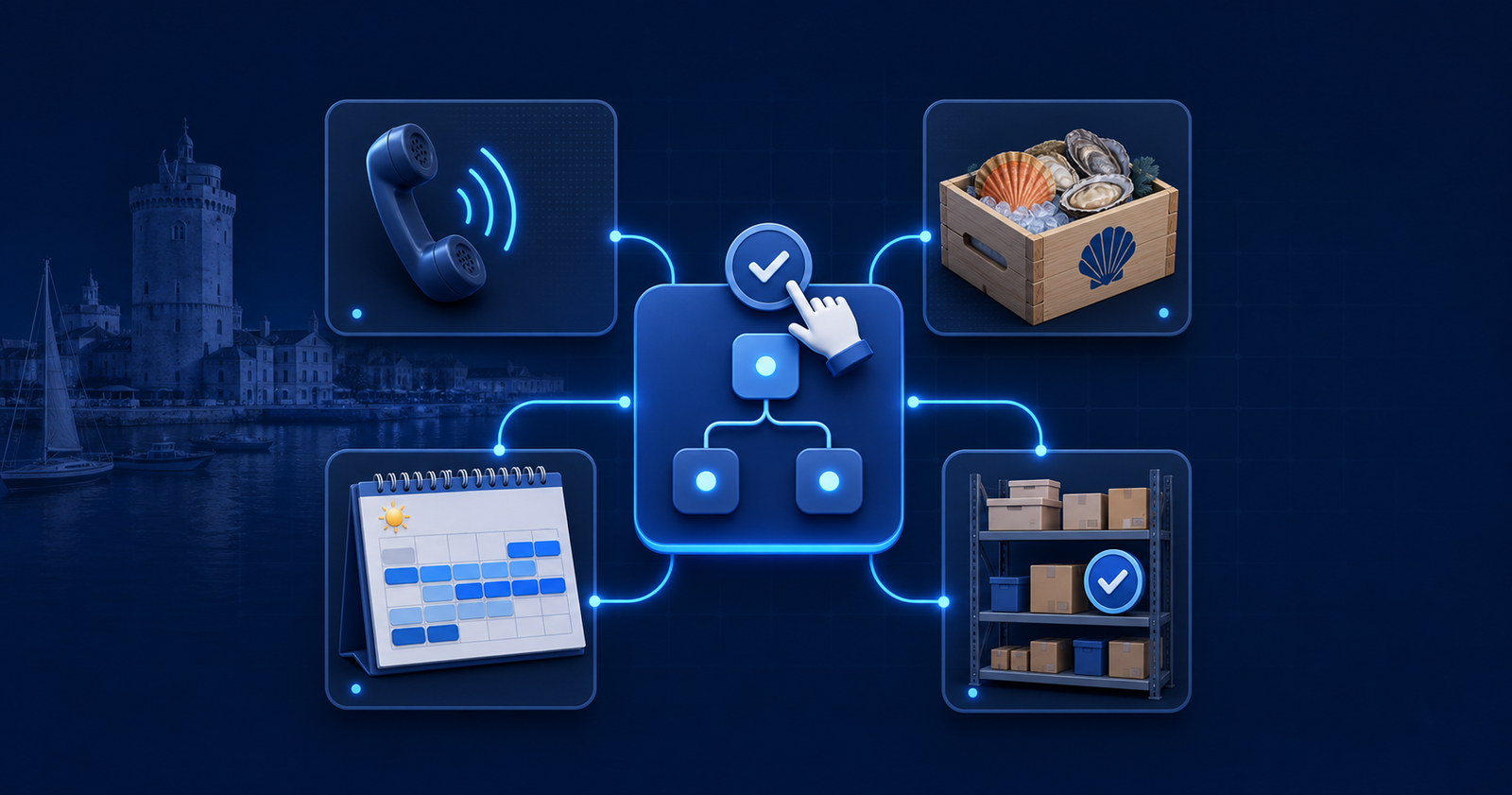
In La Rochelle, summer does not really start in July.
For many small and mid-sized businesses, the pressure builds much earlier. They need to answer enquiries, prepare orders, track supplies, organise teams and handle a growing number of calls. Then the summer rush arrives. When activity finally slows down, there is still all the work that was postponed to get through the season.
This is something I regularly see among local food suppliers, leisure businesses and shops that need to handle more volume as the city fills up.
The problem is not that these teams are not working hard enough. It is usually the opposite.
In a small business, one person may be the owner, secretary, salesperson, stock manager and administrator at the same time. They may also handle follow-ups, legal matters and customer service. As long as activity remains steady, everyone manages as best they can. But when a peak arrives, repetitive tasks suddenly take up much more of the day.
The goal is not to automate everything. It is to prepare what can be prepared so that the team can keep its time and attention for the work that really needs people.
Seasonal peaks often start before summer
The high season is easy to see: more customers, more calls, more enquiries and more unexpected situations.
But the first peak often comes earlier.
For some businesses, the weeks before summer are spent preparing sales, purchases, orders, incoming requests and new customer acquisition. Commercial and administrative work starts to pile up while activity on the ground is already accelerating.
Then priorities change during the summer. The urgent work comes first: answering, serving, delivering, organising, reassuring and following up with customers. Tasks that do not appear urgent are postponed. Prospecting, filing, certain follow-ups, spreadsheet updates and process improvements can wait.
Then September and October arrive.
Summer is over, but the backlog remains. Teams have to pick up the work they paused while preparing for the next stage of the business. This is often when they realise that part of the workload could have been anticipated more effectively.
When everyone wears several hats, small tasks become a real constraint
In a small or mid-sized business, everyday tools are often straightforward: Excel, email, a calendar, the phone and one or more business applications.
These tools are not necessarily bad. Each one usually serves a clear purpose. The difficulty appears between them and in the way the team has to use them.
Someone has to copy information, check a request, forward a file, follow up with a contact, update stock, find an earlier conversation or create a task. Individually, these actions seem quick. Repeated dozens or hundreds of times, they end up taking the time of the person who should be available for the rush.
During the summer, this manual way of working reaches its limits faster.
A small team cannot easily absorb a rise in calls and enquiries while maintaining the same level of follow-up. It has to decide what to handle now and what to postpone. This is often when useful activities are temporarily stopped, with consequences that appear weeks later.
Automation does not replace people: it helps them keep up
Useful automation does not need to transform the whole business.
It can simply trigger an action at the right time, prepare information, speed up a task or prevent someone from repeating the same manual operation all day.
For the businesses I support in and around La Rochelle, this can take several forms:
- scheduled processes that prepare or update information without daily intervention;
- triggers that start an action when a request, file or event arrives;
- tools adapted more closely to the way the team actually works;
- training to make better use of software already in place;
- semi-automated acquisition workflows;
- phone agents when the volume of calls makes them relevant.
AI is not always the answer.
In many situations, standard automation is enough. It is often simpler, more stable and better suited to repetitive work with clear rules. AI becomes useful when a task requires understanding a request, holding a conversation or handling less structured information.
In every case, the team keeps control of validations, important decisions and situations that genuinely depend on human judgement.
A call peak that could have occupied one person all day
The phone is a good example of what can become impossible to absorb during a rush.
In one of the cases I supported, a phone agent handled 1,500 calls in less than a month, with a 100% answer rate. On August 7, someone would have had to answer the phone more than 160 times in a single day if the system had not been in place.
The goal was not to remove the team from the process. It was to prevent one person from spending the day answering calls, repeating the same initial information and constantly interrupting their work.
Calls that require a decision, expertise or a specific intervention can still be passed to a person. The first level of handling no longer blocks the entire organisation.
The result is difficult to describe only in hours saved. For the person concerned, the main benefit was being able to focus on the rest of the work during an already demanding period.
Saving two hours a day, or reducing weeks of work to a few hours
Results do not always take the same form.
For some businesses, the benefit is measured in time: more than two hours recovered each day from tasks that used to be handled manually.
For others, the value is being able to complete in a few hours an acquisition task that would have taken several weeks if everything had been done by hand.
Sometimes, the most important result is simply preventing an essential task from building up throughout the summer.
Every situation is different. The time saved depends on the volume, frequency, tools already in use and what the team still needs to review itself. These results are not therefore a promise that applies identically to every business. They show that repetitive work, when properly identified, can sometimes be removed from the daily workload without disrupting useful habits.
Prepare for the next season from September onwards
The right time to think about automation is not always when the team is already overwhelmed.
After the summer, businesses often have a very clear view of what went wrong: too many calls, requests that were not answered quickly enough, files that had to be completed in the evening, postponed tasks or tools that were too complicated to use when every minute mattered.
That period is an opportunity to prepare for the next one.
This does not mean launching a major IT project. It may simply mean observing one specific task: what it requires, how often it happens, which information it uses and what still needs to be reviewed by a person.
A first automation can then provide a foundation. It removes friction, frees up time and helps the team handle the next wave of activity more effectively.
Businesses dealing with seasonal peaks in La Rochelle do not need to automate everything. They need to identify what slows the organisation down unnecessarily, before the next rush makes every improvement difficult to implement.
Are you already preparing for your next season? Let’s look at the tasks that keep coming back, the ones that block your team and the ones that could be accelerated without changing the way you work.